
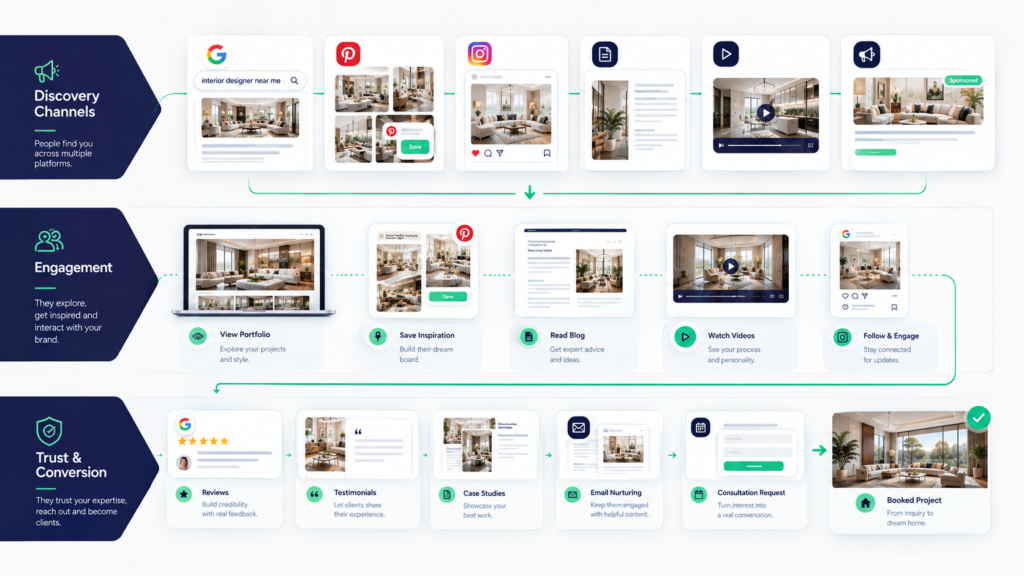
Most interior designers built their business on referrals, showrooms, and word of mouth. That still works, but it puts a hard ceiling on how many clients you can reach, and it leaves you dependent on other people’s timelines. A homeowner searching “interior designer near me” at 10 p.m., or scrolling Pinterest for kitchen inspiration, has no idea your firm exists unless your digital presence puts you in front of them.
Digital marketing for interior designers isn’t about chasing every platform or posting constantly. It’s about matching the right channel to the way people actually search for and hire a designer, visually, locally, and often after weeks of quiet research before they ever send an inquiry. Below are 15 practical, designer-specific strategies you can use to build visibility, earn trust, and turn browsers into booked consultations.
1. Build a Portfolio-First Website That Converts
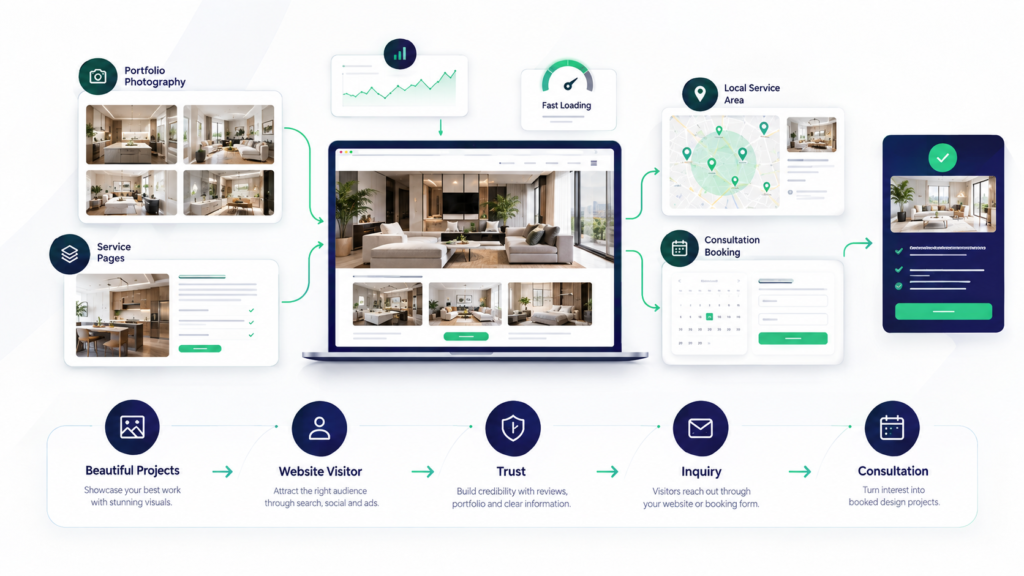
Your website is the single asset that supports every other strategy on this list; social posts, ads, and search traffic all eventually funnel back to it. For interior designers, the site needs to do two things at once: look as polished as your work and make it effortless for a visitor to take the next step.
Practical priorities:
- Lead with large, high-resolution project photography above the fold, not a generic hero banner or stock image.
- Organise your portfolio by room type or project style (kitchens, full-home renovations, coastal, modern) so visitors can self-select into what they’re looking for.
- Put a clear call to action, “Book a Consultation” or “Start Your Project”, on every page, not just the homepage.
- Keep page load speed reasonable; heavy, uncompressed images are one of the most common reasons designer sites feel slow.
- Include your service area and pricing philosophy (even if you don’t list exact rates) so unqualified leads self-filter before they contact you.
2. Invest in Local SEO to Get Found by Nearby Clients
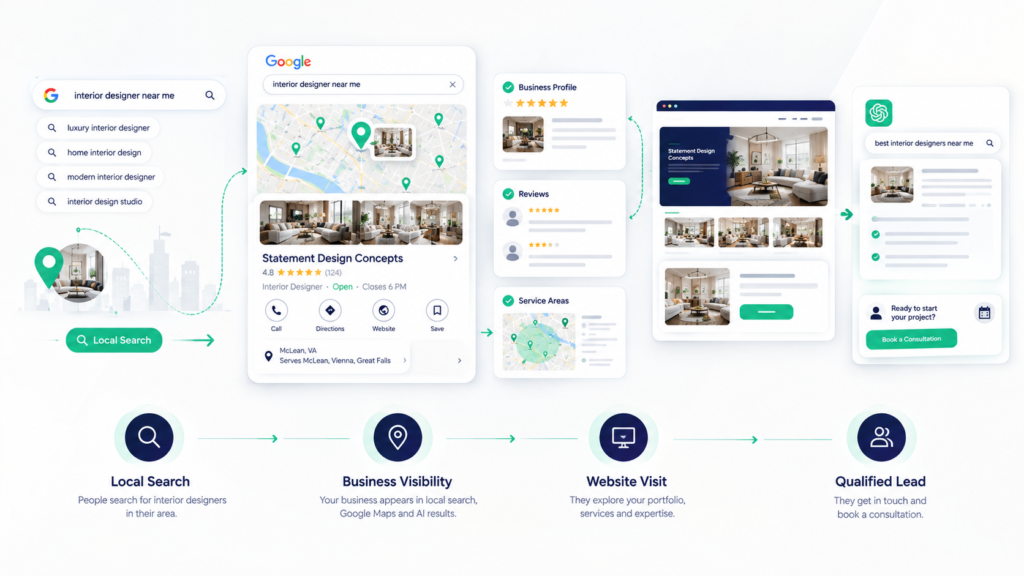
Interior design is almost always a local service, which makes local SEO one of the highest-return efforts on this list. Ranking for searches like “interior designer in [your city]” puts you in front of people who are already close to hiring.
This means optimising your Google Business Profile, using consistent business name, address, and phone information across every online directory, and building location-specific content, a page or blog post about designing homes in your specific city or region, referencing local architecture styles, climate, or common home layouts. Local backlinks matter too: getting listed in local business directories, home builder associations, or being featured by a local publication carries more SEO weight than a generic national directory listing.
3. Turn Before-and-After Photography Into a Core Content Strategy
Before-and-after transformations are the single most persuasive content format in interior design marketing because they answer the exact question a prospective client is asking: “What could this space become?” Static photos work, but slider comparisons, short video walkthroughs, and side-by-side social posts perform even better because they invite sharing.
Document every project with the same discipline: consistent lighting, matching camera angles for before and after shots, and a short caption explaining the brief, the challenge, and the decisions behind the result. This content works across your website, portfolio, social channels, and paid ads simultaneously, so it’s worth the extra ten minutes on-site to capture it properly.
4. Use Instagram and Pinterest for Different Jobs
Interior designers often treat Instagram and Pinterest as interchangeable, but they serve different stages of the client journey and reward different content.
Instagram is a relationship and reputation channel. It works best for behind-the-scenes content, client reactions, process shots, and Reels that show your personality and expertise; this is where people decide whether they’d enjoy working with you.
Pinterest is a discovery and search engine, not a social network. Users save images months or years before hiring anyone, and Pinterest content has a far longer shelf life than an Instagram post. Optimise pins with descriptive, keyword-rich titles (“Warm Modern Kitchen Renovation Ideas”) and link every pin back to a relevant page on your website, not just your homepage.
5. Start a Design Blog That Answers Real Client Questions
A blog gives Google, and increasingly, AI-powered search tools, substantive, indexable content to associate with your business beyond your portfolio pages. The most effective posts answer the specific questions prospective clients are already typing into search bars: “How much does it cost to redesign a living room?” “How long does a full home renovation take?” or “What’s the difference between an interior designer and a decorator?”
Write these as direct, useful answers rather than vague marketing copy. Open each post with a concise answer to the core question in the first two or three sentences, then expand with detail, examples from your own project experience, and practical caveats. This structure also happens to be exactly what AI overviews and voice assistants tend to pull from when generating a spoken or summarised answer.
6. Build an Email List and Nurture It Consistently
Social platforms and search rankings can change overnight; an email list is one of the few marketing assets you fully own. Offer something genuinely useful in exchange for a sign-up: a room-by-room budgeting checklist, a guide to planning a renovation timeline, or a seasonal styling lookbook, rather than a generic “join our newsletter” prompt.
Once someone is on your list, send project reveals, design tips, and occasional availability updates. The goal isn’t constant selling; it’s staying visible so that when a subscriber is finally ready to hire, your firm is the first one they think of, since interior design purchases often follow a long consideration period.
7. Treat Google Business Profile as a Lead Generation Tool, Not Just a Listing
A complete, active Google Business Profile shows up in local map results and the local pack, often before a searcher ever reaches organic results. Fill in every available field: services offered, service areas, business hours, and a detailed business description that naturally includes how you describe your design style and specialities.
Upload project photos regularly, respond to every review (positive or negative) professionally, and use the Google posts feature to share recent projects or availability. Profiles that are updated regularly tend to perform better in local search than ones that were set up once and left static.
8. Create Video Content That Shows Your Process, Not Just the Result
Photos show the finished space; video shows the thinking behind it, and that’s what builds trust with someone about to hand over a significant renovation budget. Room tours, quick “how we solved this layout problem” explainers, and short client walkthroughs all perform well because they’re easy to consume on mobile and easy to share.
You don’t need cinematic production value. A well-lit phone video with clear narration explaining a design decision and why a certain layout, material, or colour choice was made often outperforms a polished but generic reel because it demonstrates expertise rather than just aesthetics.
9. Actively Collect and Showcase Client Reviews and Testimonials
Reviews influence both human decision-making and local search rankings, yet most designers only collect them passively. Build a habit of requesting a review at the natural endpoint of a project, when the client’s satisfaction is highest, rather than hoping they’ll think to leave one on their own.
Feature testimonials near relevant portfolio projects rather than isolated on a single “testimonials” page; a quote about a kitchen renovation is more persuasive sitting next to photos of that exact kitchen. Where possible, ask permission to share specific details (“we finished two weeks ahead of schedule”, “she translated our vague ideas into an exact plan”) rather than generic praise, since specificity is what makes a testimonial credible.
10. Run Targeted Paid Ads to Generate Consistent, Predictable Leads
Organic strategies build long-term visibility, but paid advertising fills the gap while that visibility grows. Google Search ads work well for high-intent, bottom-of-funnel searches like “interior designer for kitchen remodel”, where the searcher is close to hiring. Meta ads (Instagram and Facebook) work better for visually-led awareness campaigns, retargeting people who’ve already visited your website or engaged with your content, using strong before-and-after imagery.
Keep campaigns narrow rather than broad: target your actual service radius, and send traffic to a specific landing page relevant to the ad, not your generic homepage. A designer running ads for kitchen renovations should land visitors on a kitchen-focused page with matching photography, not a general portfolio grid.
11. Partner With Complementary Local Businesses
Co-marketing with businesses that serve the same client at a different stage – real estate agents, architects, custom furniture makers, home stagers, or high-end contractors – extends your reach into an audience that’s already primed to need design services. This can be as simple as a joint Instagram takeover, a shared blog post, or a referral arrangement.
These partnerships also tend to produce stronger backlinks than generic directory submissions, since a mention on an architect’s or realtor’s website carries relevant local authority in Google’s eyes.
12. Optimise Content for AI Search Tools Can Understand and Cite It
Search is no longer limited to a list of blue links. AI overviews, chatbots, and voice assistants now summarise and answer questions directly, often pulling from content that states things clearly and specifically. To be a source these systems draw from, structure your key content, service pages, FAQs, and blog posts around direct, self-contained answers to specific questions, written in plain language rather than marketing jargon.
Use descriptive subheadings phrased as actual questions (“How much does a full home interior design cost?”), followed by a concise two-to-three-sentence answer before expanding with detail. This same structure that helps a featured snippet also helps an AI system extract and attribute an accurate answer back to your site.
13. Publish Case Studies, Not Just Portfolio Photos
A portfolio shows what a space looks like; a case study shows how you got there, which is what actually differentiates one designer from another in a prospective client’s mind. A strong case study walks through the client’s original problem, the constraints (budget, timeline, structural limitations), the options you considered, and why you landed on the final design.
This kind of content performs well in search because it’s longer and more detailed than a typical portfolio caption, and it performs well with prospective clients because it demonstrates judgement, not just taste.
14. Build a Deliberate Referral System
Referrals already drive a large share of the interior design business; the opportunity is making that process intentional instead of accidental. Ask satisfied clients directly, at project completion, whether they know anyone else planning a renovation, and make it easy for them to share your information (a simple referral card, a shareable project link, or a small thank-you incentive for referrals that convert).
This isn’t purely offline anymore: a client sharing your Instagram post or tagging you in their own home reveals functions as a modern referral, so make your content easy for happy clients to share and be tagged in.
15. Track the Metrics That Actually Predict Revenue
It’s easy to track vanity metrics—followers, likes, and page views—without knowing whether they lead to paying clients. Focus instead on a smaller set of numbers tied to your pipeline: where booked consultations actually came from (ask every new lead), which blog posts or pages generate the most contact form submissions, and which paid campaigns produce enquiries versus just clicks.
Review this monthly, not daily. Interior design has a long sales cycle, so short-term fluctuations in traffic or engagement are far less meaningful than which channels are producing qualified leads over a full quarter.
Final Thoughts
None of these 15 strategies work in isolation, and you don’t need to launch all of them at once. A realistic starting point is a website that actually converts, an optimised Google Business Profile, and a habit of documenting every project properly; those three alone create the raw material that every other channel (SEO, social, ads, referrals) depends on. From there, add channels based on where your specific clients are already looking, rather than chasing every trend at once.