


Picture a homeowner planning a whole-home renovation. Instead of opening ten browser tabs, she types one question into an AI tool: Who are the best interior designers near me for a historic home? Within seconds she gets a short list of names, each with a sentence of explanation.
If your studio isn’t on that list, she never sees your portfolio.
AI-generated answers are quickly becoming part of how people research local services, and interior design is no exception. The good news is that you don’t need a secret trick to be included. The honest news is that no one, including us, can guarantee a mention. What you can do is make your studio easy for search engines and AI tools to find, understand, and trust.
This guide explains how AI recommendations work in practical terms, then walks through eight steps to improve your chances, with an example, a simple testing routine, and a 30-day plan. For the broader picture first, see our digital marketing strategies for interior designers.
How AI Tools Decide Which Interior Designers to Mention
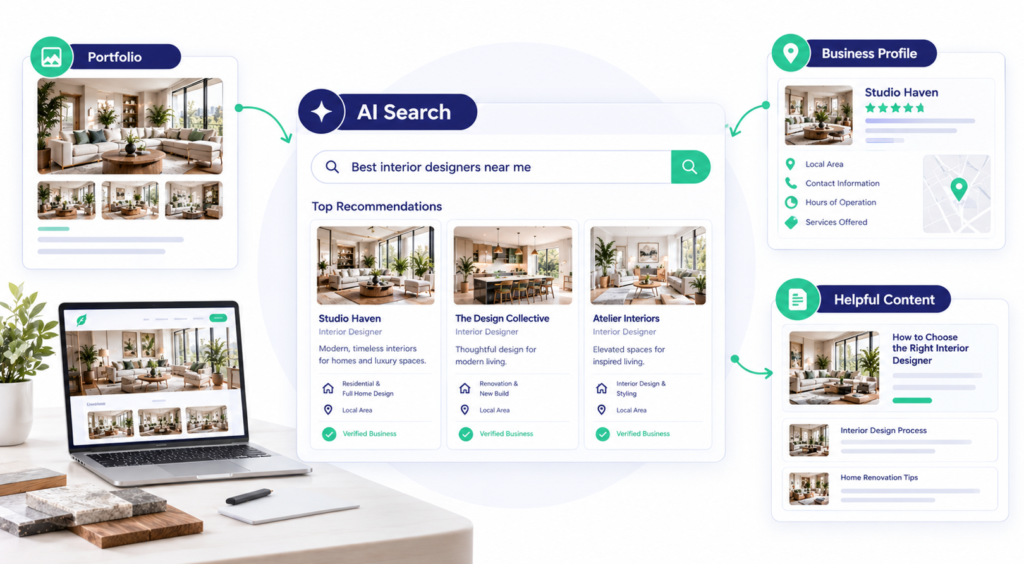
AI tools don’t publish a recipe, and they don’t all work the same way. Some pull from live web searches, some lean on what they learned in training, and many blend sources. That means there’s no single dial to turn. A few points are documented, though.
Google says the fundamentals still apply. In its guidance for site owners, Google Search Central explains that no special optimization is required to appear in AI Overviews and AI Mode, that standard SEO practices remain worthwhile, and that you don’t need special schema.org markup for these features. It also notes that these features may run several related searches across subtopics to build an answer.
That last point matters for designers. One homeowner question can trigger searches about cost, process, location, and style. A studio with helpful pages on each of those subtopics has more ways to appear than a studio with one generic Services page.
ChatGPT search uses a crawler you control. OpenAI’s crawler documentation describes OAI-SearchBot, the crawler used to surface websites in ChatGPT’s search features. Sites that opt out of it won’t be shown in ChatGPT search answers, although they can still appear as plain links. OpenAI treats its training crawler, GPTBot, as a separate setting.
Everything else is informed inference. How any tool weighs reviews, directories, or outside mentions isn’t public. So the sensible approach is to build the signals a careful human researcher would also trust: a clear website, a complete local presence, specific reviews, and credible mentions elsewhere. Treat any promise of a guaranteed AI ranking with suspicion.
8 Steps to Get Your Interior Design Business Recommended by AI
1. Make Sure Your Site Can Be Found and Read
Start with the basics many studios never check:
- Confirm your pages are indexable. An accidental noindex tag, or a staging setting left on after launch, can keep your site out of search entirely.
- Review your robots.txt file. If you want to appear in ChatGPT search, OpenAI recommends allowing OAI-SearchBot. Blocking GPTBot is a separate choice about model training and isn’t the same as leaving search.
- Verify your site in Google Search Console and fix crawl or indexing errors. Google reports that traffic from its AI features is included in your overall Search Console data.
- Keep pages fast, mobile-friendly, and well linked, so every important page is reachable from your main navigation.
- Put key information in real text, not only inside images or sliders.
2. Say Exactly What You Do, for Whom, and Where
AI can only recommend you for what it understands you do. Vague positioning gives a tool very little to match to a homeowner’s question.
Before: “We create beautiful, timeless spaces tailored to you.”
After: “We’re a Charleston interior design studio specializing in historic home renovations, from full-home design to kitchen and bath updates.”
(The studio above is a hypothetical example.)
The second version names the service, the project type, and the location. Use the same plain-language description on your homepage, About page, Google Business Profile, social bios, and directory listings. Cover four things: what you offer, the projects you handle best, where you work, and who you’re right for.
3. Build a Dedicated Page for Each Service
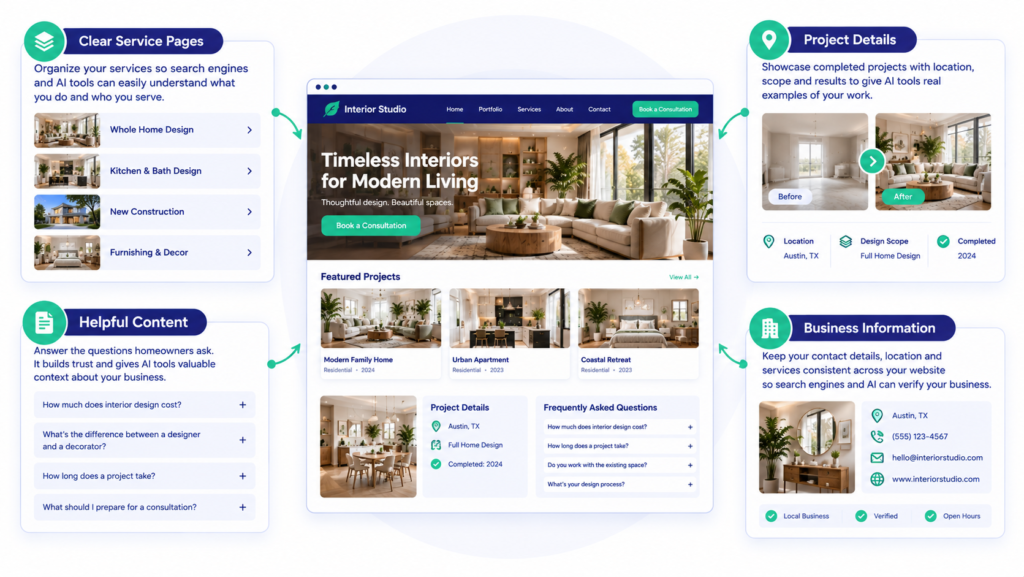
A single page that lists every service rarely answers a specific question. Create separate pages for the work you most want, such as whole-home design, kitchen and bath design, or new construction consulting.
Each page should include:
- Who the service is for
- What’s included and how the process works
- A typical timeline and what affects it
- Two or three relevant projects
- A short FAQ and a clear consultation button
Link these pages from your main navigation and from related project pages. Structured data, such as LocalBusiness markup, can help machines interpret your pages, but it isn’t required for Google’s AI features, and it should always match what visitors can actually see on the page.
4. Answer the Questions Homeowners Actually Ask
People ask AI tools full questions, so your site should contain full answers. Typical examples:
- How much does a full-service interior designer cost?
- How do I choose an interior designer for a renovation?
- What’s the difference between an interior designer and a decorator?
- How long does a whole-home design project take?
- What should I prepare before a first consultation?
Write each heading as the question, answer it directly in the first two or three sentences, and then add detail: ranges, variables, trade-offs, and examples from your own projects. Collect real questions from discovery calls so you’re writing for actual clients, not guesses. For topic ideas, browse our content marketing ideas for interior designers.
5. Get Your Google Business Profile and Local Listings in Order
Local business information is a common input for location-based questions, so it pays to get it right.
- Complete your Google Business Profile: accurate primary category, a list of your real services, hours, a plain-language description, and regular project photos.
- Keep your name, address, and phone number identical across your website, social profiles, and directories.
- Claim listings that matter in your field, such as design directories and professional associations you actually belong to, and fix anything outdated.
- Remove duplicates and correct old addresses or phone numbers.
- List only the areas you genuinely serve.
6. Collect Specific, Honest Reviews
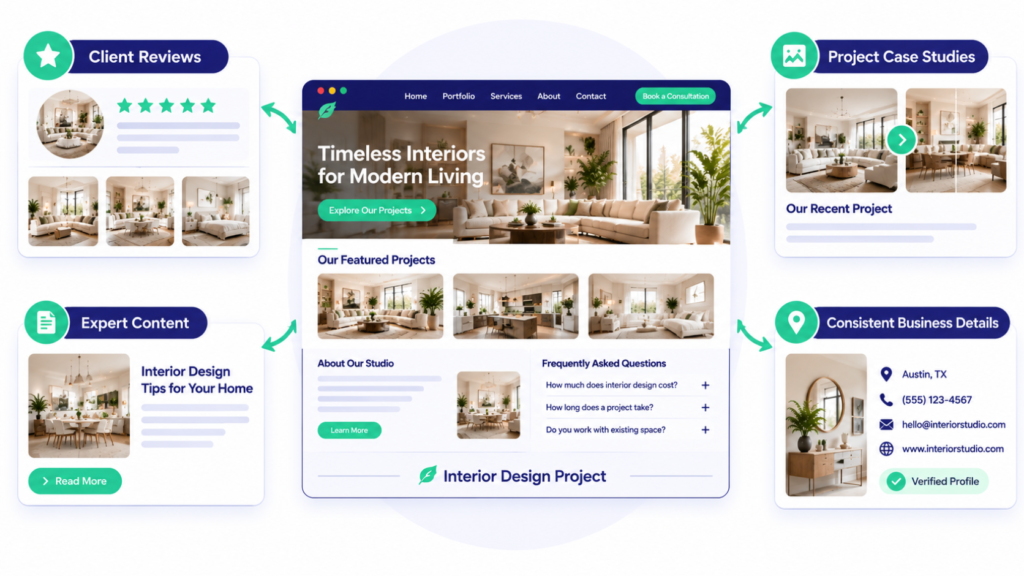
A review that says “Great work!” tells a reader, human or machine, very little. A review that mentions the project type, the challenge, and what the experience was like gives much more to work with.
- Ask every client near the end of a project, not only the ones you expect to be happy.
- Suggest they mention the type of project and what stood out, without scripting their words.
- Send a direct link to your Google review page.
- Reply to every review, positive or critical, in a calm and professional tone.
- Never buy reviews, offer incentives for them, or post invented testimonials.
7. Earn Credible Mentions Beyond Your Own Site
What others say about your studio supports what you say about yourself. Look for real opportunities, such as:
- Features in local press or design publications
- Pages on builder, architect, or showroom partner sites that show a project you worked on together
- Awards, speaking invitations, and podcast interviews
- Professional association memberships and directory profiles
- Photographer and stylist credits that link back to your project pages
Skip paid link schemes. A handful of relevant, genuine mentions is worth more than a long list of low-quality ones.
8. Show Real Expertise and Proof
Homeowners, and the systems that serve them, look for evidence that you know what you’re doing.
- Bios for the people behind the studio, with experience, credentials, and a real photo
- Detailed project pages that explain the brief, the challenge, the solution, and the timeline
- Real testimonials and case studies, used with permission. Only publish results you can back up.
- Fresh content. Review your key pages at least once or twice a year so fees, services, and processes stay accurate.
What This Looks Like in Practice
Imagine the Charleston studio from step 2. It started with one Services page, vague copy, a Google profile with three old photos, and no content about cost or process.
Over a few months it rewrites its homepage with specific positioning, builds a page called “Historic Home Interior Design in Charleston,” and publishes an article explaining how its fees work. It updates its Google profile, matches its details across directories, and asks recent clients for reviews that describe their projects.
None of this guarantees a mention. But when a homeowner asks about designers for a historic home, the studio now gives search engines and AI tools several clear, consistent, trustworthy things to work with. (This is an illustrative scenario, not a client result.)
How to Check Whether AI Tools Mention Your Studio
You don’t need special software to start.
- Write 10 to 15 realistic prompts covering your services, location, project size, and style. For example: “Best interior designer for a kitchen remodel in [your city]” or “How much does a luxury interior designer charge?”
- Run them monthly in ChatGPT, Google’s AI features, and any other tools your clients might use.
- Log what you see: whether you’re mentioned, which competitors appear, and which sources the tool cites.
- Don’t over-read a single result. Answers vary by person, location, and time, so look for patterns across several runs.
- Track real inquiries. Check Search Console for Google traffic, and add “AI tool” as an option when you ask new leads how they found you.
- Fix what you find. If a tool cites an outdated directory listing, update it. If it misses a service you offer, strengthen that service page.
Mistakes to Avoid
- Buying fake reviews or posting AI-generated testimonials
- Mass-producing generic articles with no real expertise in them
- Keyword stuffing or hiding text
- Blocking search crawlers by accident
- Believing anyone who guarantees a placement in AI answers
- Letting your business details differ from site to site
- Treating AI visibility as separate from good SEO and a strong website
A 30-Day Action Plan
- Week 1: Check indexing and robots.txt, verify Search Console, and write one clear positioning sentence for your studio.
- Week 2: Audit your Google Business Profile and directory listings, and fix inconsistencies.
- Week 3: Publish or rewrite one service page and one question-based article, and ask five recent clients for reviews.
- Week 4: Run your first set of AI prompts, pitch one local feature or partner mention, and plan next month’s content.
You’ll find more ideas in our Marketing category and on the GrowthVia blog.
Conclusion
Getting recommended by AI isn’t a separate game with its own secret rules. It’s an extension of work that already helps your business: a site that’s easy to read, a precise explanation of what you do, helpful answers to real questions, a consistent local presence, and proof that clients trust you.
Start with the basics this month, then keep testing and improving. The studios that do this steadily are giving every search engine and AI tool the clearest possible reason to mention them.