
Most interior designers don’t have a talent problem. They have a visibility problem, a follow-through problem, or both.
Referrals and word of mouth built many studios, and they still matter. But they’re unpredictable, and the homeowners you’d most like to work with are researching online first: searching Google, saving ideas on Pinterest, and scrolling Instagram before anyone sends an inquiry.
Good marketing for interior designers does two jobs. It helps the right people find you, and it helps them understand what working with you is actually worth: your process, your judgment, your ability to protect a budget and a timeline. A beautiful photo can’t explain that on its own.
This guide gives you ten practical interior design marketing ideas, each with a realistic example and steps you can start this month. For the big picture first, see our 15 digital marketing strategies for interior designers.
A quick note on the examples: the studios below are hypothetical scenarios built to show how an idea works in practice. They are not client case studies, and nothing here is a promise of specific results.
1. Turn Your Portfolio Website Into a Client-Qualifying Tool
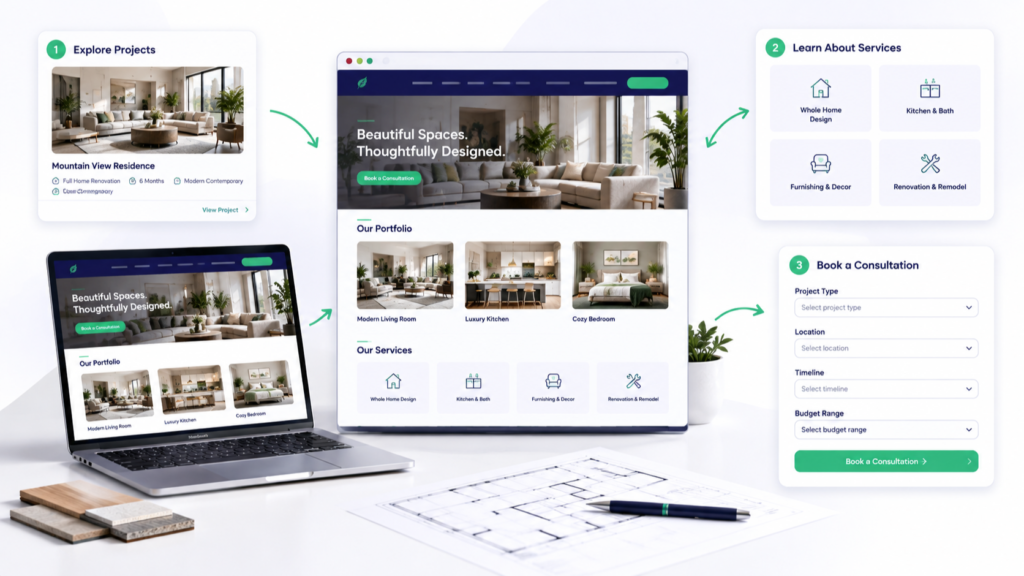
Your portfolio is where every other marketing effort lands, so it has to do more than look good. The best designer websites help a visitor decide three things quickly: this studio does the kind of project I have, at the level I expect, and I know what happens next.
Context, process, and a thoughtful inquiry form do the rest, and they quietly screen out poor-fit inquiries.
Example
Imagine a small Denver studio that specializes in mountain-home renovations. Its site shows 40 uncaptioned photos, so visitors admire the work but can’t tell whether the studio handles full renovations. It rebuilds around ten projects, each with the property type, scope, timeline, client goals, and two or three design decisions, ending with “Planning a similar project? Tell us about it.” The inquiry form now asks about project type, location, timeline, and budget range.
How to put it into practice
- Group projects by type of work, such as whole-home renovation, kitchens and baths, or new construction.
- Write a short project summary (150 to 300 words) covering the brief, the main challenge, and how you solved it.
- Add a “How we work” page that explains your phases and what your fee covers.
- Use a qualifying inquiry form with fields for project type, location, timeline, and a budget range dropdown.
- Keep one primary call to action on every page, such as “Request a Consultation,” and compress images with descriptive alt text so pages load quickly.
2. Build Service Pages That Match How Clients Search (Interior Design SEO)
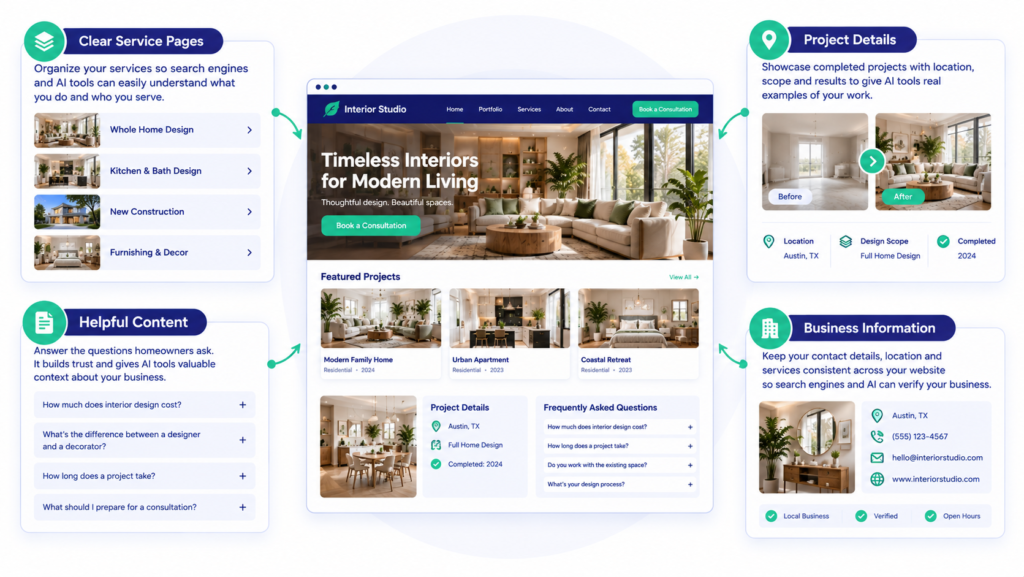
Most designer websites have a single “Services” page that lists everything in a paragraph. That’s a missed opportunity for interior design SEO. Search engines (and AI answer tools) work best when each page has one clear topic, and homeowners search for specific needs, not for “services.”
Dedicated service pages also give you a place to explain your value in detail: who the service is for, what’s included, and how it works.
Example
Picture a three-person Scottsdale studio whose Services page reads “Full-service design, kitchens, baths, furnishing, and more.” It replaces that page with two focused ones, whole-home design and kitchen and bath design. Each names the city, shows three relevant projects, explains the process, and answers the five questions clients ask most on a first call.
How to put it into practice
- List the three to five services you most want to sell, ranked by profitability and how much you enjoy the work.
- Phrase each one the way a client would say it, such as “kitchen design” or “interior designer for new construction.” Google’s autocomplete and “People also ask” box show real phrasing, and Google Search Console shows which searches already bring people to your site.
- Give each service its own page with a unique title tag, a clear H1, and an opening paragraph that says who it’s for.
- Include the essentials: what’s included, your process, a typical timeline, two or three sample projects, a short FAQ, and a consultation button.
- Link project pages to the matching service page, and avoid cloning pages by swapping out city names.
3. Make Local SEO Work Harder With Your Google Business Profile
Interior design is a local business, even for studios that take on projects in several cities. When someone searches for an interior designer near them, a complete Google Business Profile (GBP) can put your studio in front of them in the map results before they ever click a website.
Example
Consider a Raleigh studio serving the city and nearby suburbs. Its profile has a thin description and three photos from two years ago. The owner sets the right primary category, lists specific services, adds the areas it genuinely covers, uploads captioned project photos, and asks every finished client for a review. She also publishes a page about a recent suburban project, covering the home’s architectural style and what the design had to solve.
How to put it into practice
- Claim and verify your profile, and choose the primary category that best matches your core work.
- List specific services and write a plain-language description of your specialty and ideal clients.
- Follow Google’s guidelines for service-area businesses, and list only areas you actually serve.
- Add real project photos regularly, and keep your name, address, and phone number consistent everywhere.
- Reply to every review in a calm, professional tone, and publish local pages only where you’ve completed real projects.
4. Publish Content That Answers the Questions Clients Ask Before They Call
Content marketing for interior designers often turns into “post more photos.” A more useful approach is to treat every question prospects ask in a first call as a content topic, especially questions about money, timelines, and process. These are the topics prospects worry about most, and the ones fewest designers answer openly.
For a wider menu of topics, see our content marketing ideas. The idea here is narrower: content that does selling work for you.
Example
A hypothetical Chicago studio notices that nearly every discovery call includes the same question: “How do you charge?” The owner writes “How Interior Design Fees Work: Hourly, Flat Fee, and Cost-Plus,” explaining each model and which one the studio uses and why, without publishing exact rates. She then sends the link to every new lead before the first call, so conversations move from “what do you cost?” to “what’s the right scope for our home?”
How to put it into practice
- Keep a running list of client questions from calls, emails, and DMs. That’s your editorial calendar.
- Pick topics tied to hiring decisions: fees, timelines, process, designer versus decorator, and how to set a renovation budget.
- Answer the main question in the first two or three sentences, then explain the details. This suits featured snippets and AI-generated answers too.
- Use real examples from your projects and explain trade-offs honestly.
- Link each article to the relevant service page, end with a clear next step, and send it to leads.
5. Run Pinterest and Instagram as One Visual System
Pinterest works like a visual search engine, and a good pin can keep sending visitors long after you post it. Instagram is where people judge your taste, personality, and credibility. Treating them as two full-time projects leads to burnout; building both from the same project assets keeps the workload manageable.
The key habit is planning content at the moment you finish a project, not weeks later when you’re trying to find usable photos.
Example
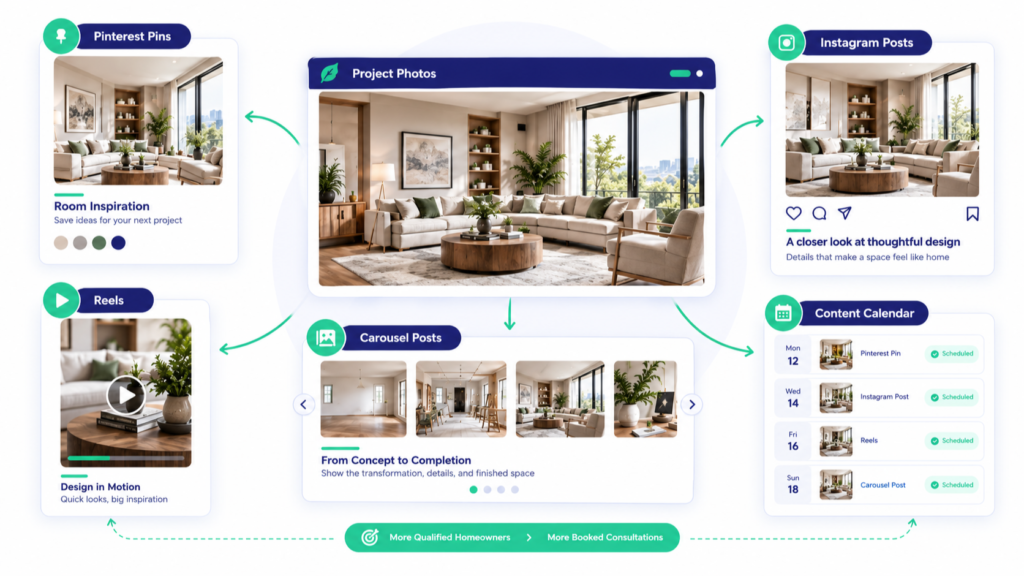
A hypothetical Atlanta studio finishes a primary bedroom suite and schedules a half-day photo session. From that single shoot, it plans:
- One project page on its website
- Five pins with different crops and keyword-rich titles, all linking to that project page
- One Instagram carousel that walks from the brief to the reveal
- One Reel showing a material or layout decision
- Three Stories featuring details and process moments
- One feature in its next email
The studio isn’t creating six separate pieces of content. It’s publishing six views of one project.
How to put it into practice
- Create a shot list for every project with wide, medium, detail, and vertical shots (vertical suits Pinterest).
- Name boards the way people search, such as “Warm Modern Primary Bedroom Ideas,” and link every pin to a specific project or service page.
- Use Instagram captions to explain the decision, not just describe the photo. Our content marketing ideas can supply plenty of caption topics.
- Pin your three best posts to the top of your profile so they represent the work you want more of.
- Point your bio link to a page built to convert, not a generic homepage.
- Choose a cadence you can sustain. A modest, consistent schedule beats a burst of daily posting followed by silence.
Both platforms take time to build momentum, so treat them as long-term visibility channels rather than quick lead sources.
6. Use Email to Nurture People Who Aren’t Ready Yet
Many of the best inquiries aren’t ready to start next month. A homeowner might be six to twelve months from renovating, saving money, or still comparing designers. If your only follow-up is “let me know if you’re ready,” they drift to whoever stayed in touch. Email works best here when it’s useful, personal, and low-pressure.
Example
A hypothetical Seattle studio offers a free “Renovation Planning Checklist” on its website. Anyone who downloads it or sends an inquiry but doesn’t book a consultation enters a short sequence:
- Email one: What to expect when working with the studio, in plain terms.
- Email two: A project story that resembles the reader’s situation.
- Email three: A practical guide on how to think about renovation budgets.
- Email four: A soft invitation to book a consultation when they’re ready.
After the sequence ends, subscribers receive a quarterly update featuring a recent project and one planning tip.
How to put it into practice
- Offer something genuinely useful in exchange for an email address, such as a planning checklist or budgeting worksheet.
- Segment by project type, so a kitchen client doesn’t get whole-home content, and keep past clients on a separate list for referrals and repeat work.
- Write like a person: short emails, a real sender name, one clear call to action.
- Follow email regulations: include an unsubscribe link and your business address, and only email people who’ve opted in.
- Track replies and bookings, not just opens.
7. Build a Referral System Around Trade Partners and Past Clients
Most designers already get referrals. The opportunity is to stop leaving them to chance. A referral is often the most qualified lead you’ll receive because the prospect arrives with trust already built.
The best referral sources are rarely random friends. They’re professionals who meet your ideal client before you do: architects, builders, real estate agents, landscape designers, and other trades.
Example
A hypothetical Charlotte studio lists the professionals who meet high-end homeowners at the start of a project: two builders, an architect, two real estate agents, and a landscape designer. It meets each quarterly and sends a one-page sheet covering the projects it’s best suited for, typical timelines, and how to make an introduction. For past clients, it sends a handwritten note six months after installation with a gentle line: “If you know anyone planning a project, we’d be glad to help.”
How to put it into practice
- Map your referral sources: the professionals and past clients most likely to meet people who need you.
- Create a short “who we’re best for” sheet covering ideal project types, scope, and timeline.
- Make introductions easy with a short email template a partner can forward in under a minute.
- Add “How did you hear about us?” to your inquiry form, and thank every referrer, even when the referral doesn’t convert.
- Return the favor by referring clients to your partners when it’s a good fit.
If you’re considering paying referral fees, check the rules for your state and profession first. Some arrangements are restricted or require disclosure.
8. Collect Testimonials That Prove the Specific Thing You Want to Be Hired For
Generic praise like “Great designer, loved working with her!” is nice but forgettable. The testimonials that persuade prospects speak to the worries they have before hiring: Will the project stay on budget? Will the designer listen? Will the process feel organized?
Targeted testimonials help you communicate value in a client’s own words, which is more convincing than anything you can say about yourself.
Example
A hypothetical Nashville studio wants more full-renovation clients. After a project wraps, the owner asks a few specific questions instead of “Can you leave a review?” One client describes how the designer kept the project organized through the budget phase. With permission, the studio places that quote on its whole-home design page beside related project photos and asks the client to share a version on Google.
How to put it into practice
- Ask right after the reveal or a few weeks after installation, when the experience is fresh.
- Use guiding questions: What worried you before hiring us? What surprised you about the process? How did we handle budget and timeline?
- Ask permission to use the client’s name, photo, and project details, and send a direct link to your Google review page.
- Place each testimonial near relevant content, such as a kitchen quote beside kitchen projects, and reply to reviews so prospects see how you communicate.
- Don’t offer incentives for reviews. Google’s policies prohibit it, and authentic reviews are more persuasive anyway.
9. Use Paid Ads to Reach Ready Buyers and Re-Engage Near-Buyers
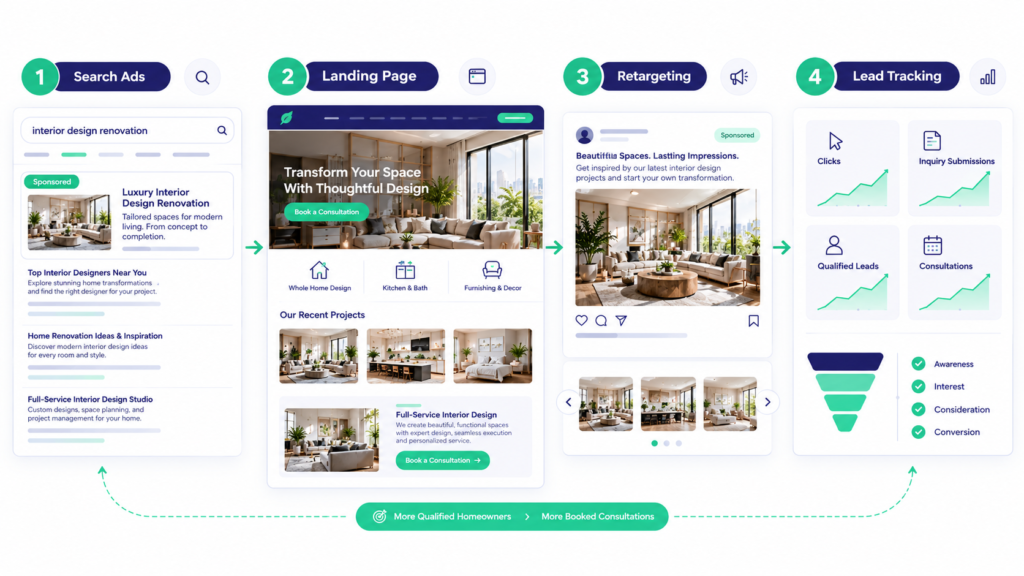
Paid advertising can fill the gap while organic channels build momentum, but it works best when it’s narrow and measured. A common mistake is paying for broad exposure and hoping some of it turns into inquiries. A better approach is to split your budget into two jobs: capturing people who are actively searching, and reminding people who already showed interest.
Example
A hypothetical Atlanta studio wants more whole-home renovation clients within a specific service area. It runs two small campaigns:
- Google Search ads for phrases like “interior designer for home renovation” in its service area, linked to a dedicated whole-home design page rather than the homepage.
- Meta (Instagram and Facebook) retargeting that shows a project story and a planning guide to people who visited its project pages but didn’t inquire.
The owner measures success by cost per qualified consultation booked, not clicks.
How to put it into practice
- Work out what a consultation is worth. Multiply your average project fee by your approximate close rate. That tells you how much you can reasonably spend to book one.
- Start with one service and one geographic area. Expand only after you see what works.
- Send traffic to a dedicated landing page with matching photos, a clear process explanation, and a qualifying form.
- Add negative keywords such as “free,” “DIY,” “jobs,” or “course” to avoid irrelevant clicks, and review the search terms report often in the early weeks.
- Track calls and form submissions all the way to booked consultations.
- Use your best project photography in visual campaigns and test one change at a time.
Results vary by market, budget, and competition, and no one can promise specific numbers. If you’d like help planning or managing campaigns, that’s part of what we do at GrowthVia.
10. Fix Lead Follow-Up Before You Spend More on Lead Generation
This is the idea most designers skip, and often the most valuable. If you’re on job sites or in client meetings most of the day, inquiries can sit for hours or days, and high-intent homeowners usually contact more than one studio.
Example
A hypothetical Boston studio principal spends most weekdays on site visits. Website inquiries sit until the evening, and missed calls often go unreturned until the next day. She builds a simple follow-up system:
- Within minutes: An automatic email and text confirm the inquiry was received and include a link to book a consultation.
- For missed calls: An automatic text goes out: “Sorry we missed you. We’re with a client right now. You can book a time here, or reply with a good time to call.”
- Day one: If no booking has been made, she sends a short, personal message.
- Days three and seven: She follows up with a relevant project story or planning guide.
- After a consultation: A proposal follow-up goes out within two business days.
How to put it into practice
- Audit your response time by checking how long recent inquiries waited for a reply.
- Centralize inquiries from your form, phone, email, and DMs in one place.
- Set a response standard, such as replying to every inquiry the same business day, and write three to five templates to personalize.
- Add a calendar booking link so interested leads can schedule without back-and-forth.
- Get consent before texting, include an opt-out, and review stalled leads monthly.
This kind of automated follow-up is something we build for studios at GrowthVia, but you can start with a basic version using your current email and calendar tools.
Where to Start: A Simple Way to Choose
You don’t need to launch all ten ideas at once. Match your starting point to your biggest bottleneck:
- Not enough inquiries? Start with ideas 2, 3, and 4 to build your search foundation.
- Inquiries arrive but don’t book? Start with ideas 1, 8, and 10.
- Want more volume sooner? Get ideas 1 and 10 in place first, then add idea 9.
- Mostly referral-driven? Strengthen ideas 7 and 6, then add visibility with ideas 3 and 5.
You can find more strategies in our Marketing category and across the GrowthVia blog.
Conclusion
The most effective interior design marketing doesn’t come from doing everything. It comes from making sure the right people can find you, understand your value, and get a fast, helpful response when they reach out.
Pick one idea from this list and implement it fully this month. Then add another. Over time, a clearer website, a stronger local presence, useful content, and reliable follow-up work together, and your marketing starts producing the kind of inquiries you actually want.