

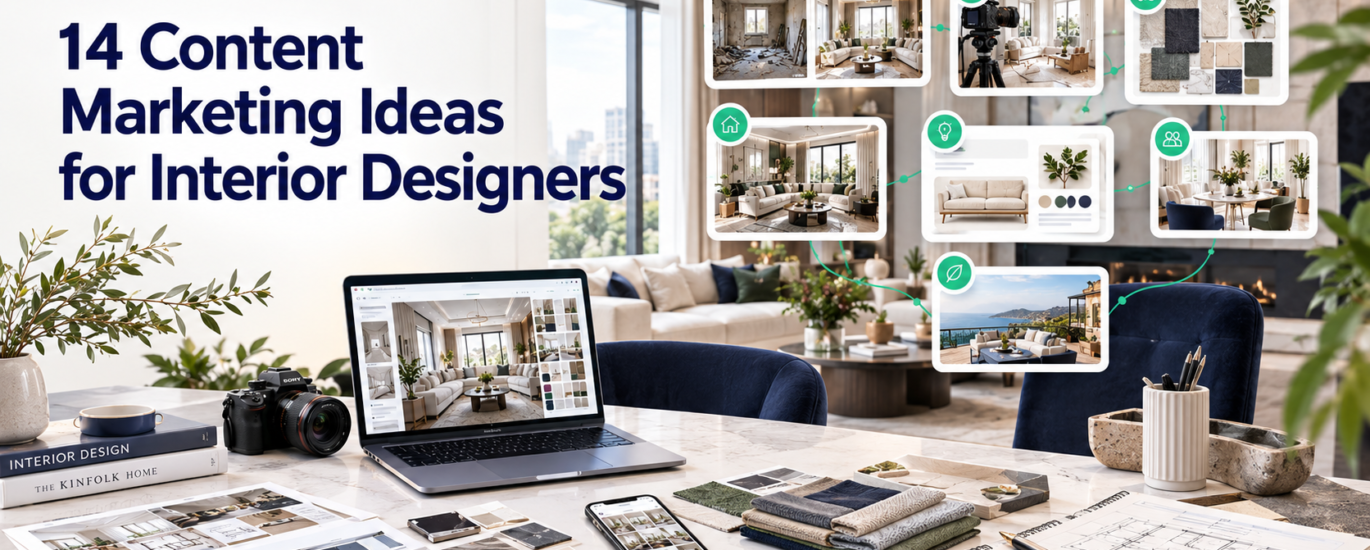
Knowing you should be posting content is easy. Knowing what to actually post, week after week, without repeating yourself or running out of ideas, is the part most interior designers get stuck on. The problem usually isn’t a lack of platforms. It’s a lack of a content system, a defined set of formats you can return to project after project instead of staring at a blank caption box.
The 14 ideas below are specific content formats, not marketing channels. Each one is something you can plan for during a project (not scramble to create after it’s finished), and each does a different job: some build trust, some demonstrate expertise, and some are built to get shared. Use this as a rotation, not a checklist to complete once.
1. Before-and-After Transformation Reveals
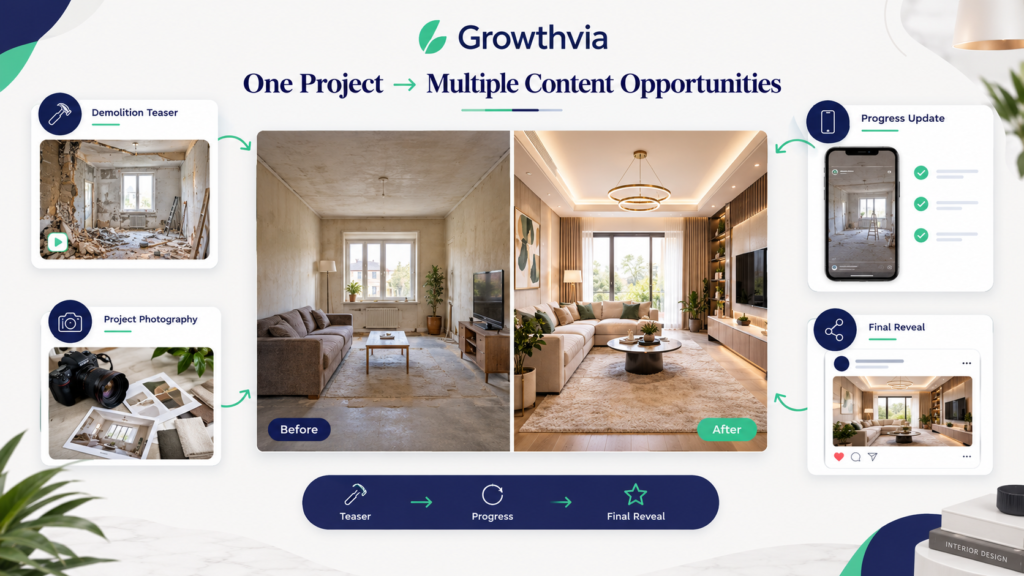
This is the highest-converting content format in interior design because it directly answers “What could this space become?” The mistake most designers make is treating it as a single post instead of a small content series: a teaser during demolition, a mid-project progress shot, and the full reveal, spaced out over several weeks.
For the reveal itself, match the camera angle and lighting between the before and after shots as closely as possible. Small inconsistencies undercut the impact. Add one sentence of context about the brief or constraint you were solving, not just “swipe to see the after.”
2. Behind-the-Scenes Process Content
Finished rooms get the likes, but process content is what builds trust with someone about to hand you a large budget. Film the messy middle: sourcing trips, fabric samples spread across a table, a sketch being revised, and a tricky layout problem being solved on-site.
This content doesn’t need polish and, in fact, performs better without it. A quick phone video with real narration (“this wall had to move because…”) reads as more credible than a produced clip. It’s also the easiest content to batch, since you’re capturing it while you work rather than staging it afterward.
3. “Ask the Designer” Q&A Series
Collect real questions, whether from past clients, DMs, or common consultation questions, and answer them directly on camera or in a short written post. Topics like “how do I mix metals in a kitchen” or “do I need to hire a designer for one room” work well because they’re the exact phrases people search for.
This format does double duty: it’s genuinely useful standalone content, and each answer can later be repurposed into a blog post or FAQ page, since you’ve already done the work of identifying the real questions your audience has.
4. Budget Breakdown Posts
“What this room actually costs” content consistently outperforms vague pricing talk because it’s specific and useful, and it pre-qualifies leads who reach out afterward. Break down a completed project by category: furniture, materials, labour, and design fee, without needing to publish your standard rate card.
Being specific here does more for your credibility than it costs you in privacy. A designer willing to show real numbers reads as more trustworthy than one who keeps everything vague, and it filters out enquiries from people whose budget was never going to match your services.
5. “Mistakes to Avoid” Educational Content
People researching a renovation are often more anxious about getting it wrong than excited about getting it right, which makes mistake-focused content genuinely useful rather than just a content gimmick. Cover things like common layout errors, lighting mistakes, or the wrong order to make decisions in (paint before furniture, for example).
Frame these from real project experience rather than generic advice. “We’ve fixed this three times this year” carries more weight than a listicle of textbook rules, and it demonstrates pattern recognition that only comes from doing the work repeatedly.
6. Seasonal and Trend-Reaction Content
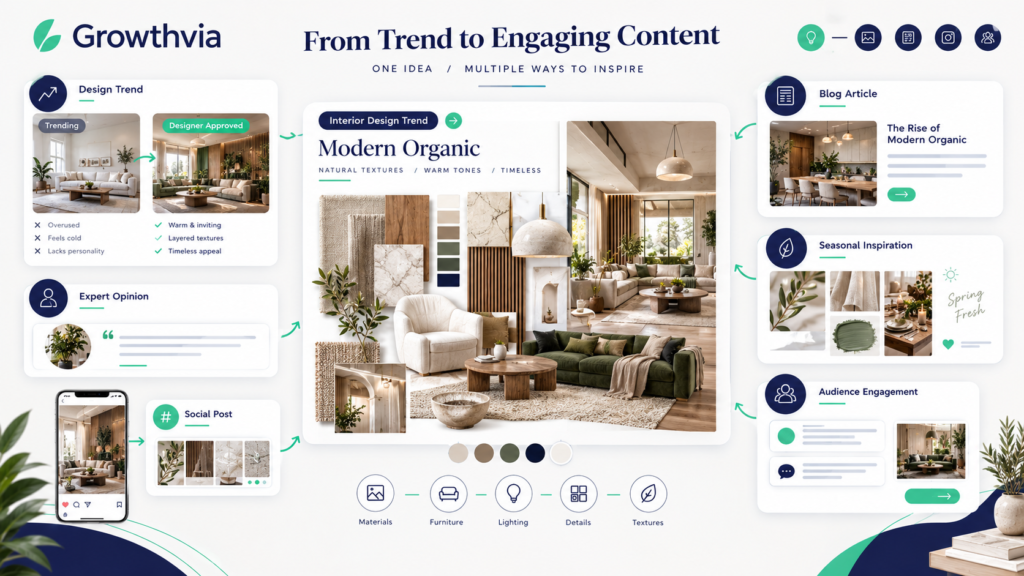
Reacting to a seasonal moment or a trending design topic (a colour of the year announcement, a viral home makeover, a shift like the return of maximalism) gives you a natural reason to post and taps into search interest that’s already happening. The key is adding your own point of view rather than just summarising the trend.
Say clearly whether you’d actually recommend the trend for real homes and why, or how you’d adapt it. A confident, specific opinion performs better and demonstrates expertise more than neutral trend reporting.
7. Room-by-Room Style Guides
Long-form guides, such as “how to layout a small primary bedroom” or “lighting layers for an open-concept living room”, build search visibility because they match how people actually search, and they let you demonstrate depth on a specific topic rather than general taste. These work best as blog posts that you then break into shorter social clips.
Structure each guide around the actual decisions involved (layout, lighting, materials, colour) rather than a loose list of tips, so it reads as a genuine framework rather than filler.
8. Mood Board and Concept Reveals
Sharing the concept board before the finished space gives your audience a reason to follow a project over time, and it shows the thinking that connects an early idea to a final result. Pair the mood board with a short explanation of the one or two decisions that anchored the whole direction: a specific tile, a client’s request, or a piece of existing furniture you had to design around.
This format works particularly well on Pinterest, where boards and concept-stage imagery tend to get saved and revisited far more than finished-room photography alone.
9. Source Lists and Shoppable Roundups
Round up specific products from a completed project, such as the exact paint colour, the light fixture, or the sofa, into a single post or blog page. This is some of the most-saved content in the interior design space because it answers a direct question (“where is that from?”) that finished-room photos alone can’t.
Even if you don’t run a formal affiliate programme, a well-organised source list keeps people on your content longer and gives them a concrete reason to bookmark or return to the post.
10. Renovation Diaries and Project Timelines
Rather than one before-and-after post, document a project as a running series across its full timeline: demo, framing, install, styling, posted in near-real time or as a structured recap. This format rewards consistency: followers who see week one are more invested in seeing week eight.
It also produces a large amount of raw content from a single project, which solves the “what do I post” problem more efficiently than trying to generate fresh ideas from scratch each week.
11. Client Story Case Studies
A case study goes further than a portfolio caption by walking through the client’s actual problem, the constraints you were working within, the options you considered, and why you landed on the final decision. This is longer-form content, usually a blog post, and it’s what differentiates your judgement from your aesthetic.
Include at least one constraint or trade-off you had to navigate, such as a tight budget, a load-bearing wall, or a client’s competing preferences. Case studies that only show the smooth, successful parts of a project read as less credible than ones that acknowledge what made it genuinely difficult.
12. Style Quizzes and Interactive Content
A short quiz (“What’s Your Design Style?”) is one of the few content formats that invites active participation instead of passive scrolling, and it’s a natural, low-pressure way to collect an email address in exchange for a personalised result. Keep it short, around five to seven questions, and make the results specific enough to feel personal rather than generic.
This works well as a lead magnet linked from social bios and paired with a short follow-up email sequence based on the result someone gets.
13. “Design Explained” Educational Breakdowns
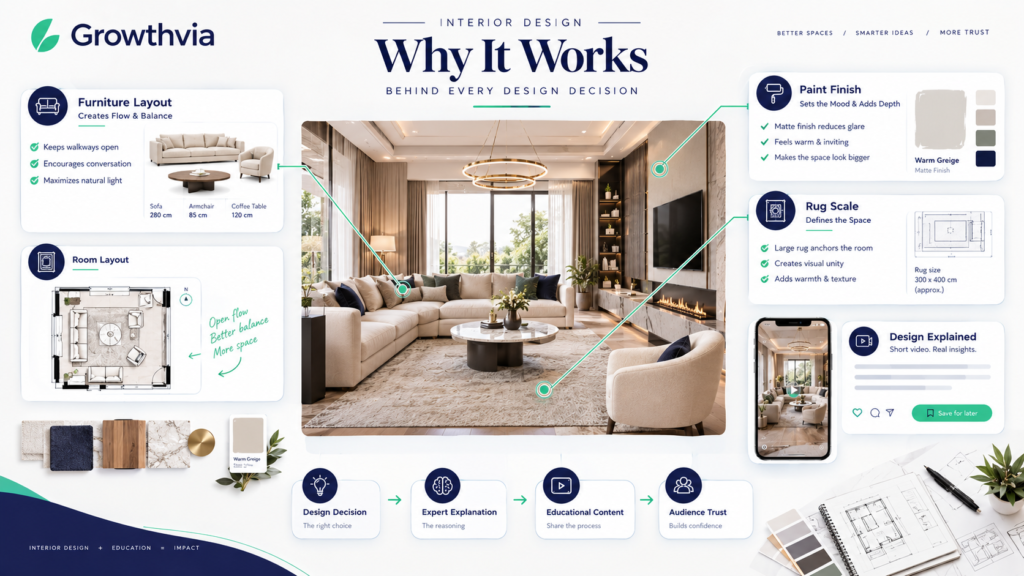
Take one specific decision from a real project and explain the reasoning behind it in isolation: why this particular furniture layout, why this paint sheen in this room, and why this scale of rug. These short breakdowns demonstrate expertise more directly than a finished-room photo, because they show your reasoning process rather than just the outcome.
This format also translates well into short-form video, since a single clear explanation fits naturally into a 60-90 second clip.
14. User-Generated Content and Client Home Reveals
Encourage past clients to share their own reveal, whether that’s a video of them seeing the finished space for the first time or their own social post tagging you, and republish it with permission. This content tends to feel more authentic than designer-produced content because it is genuinely unscripted, and it functions as a modern referral: their followers see it, not just yours.
Make resharing easy by sending clients a simple, tagged post template or asking directly at project handoff whether they’d be comfortable sharing their reaction.
Final Thoughts
The designers who post consistently aren’t the ones with the most ideas. They’re the ones who’ve picked a handful of repeatable formats and built them into how they document every project, not something they figure out after the fact. Start with two or three formats from this list that fit how you already work, capture the raw material as you go, and expand into the rest once that rhythm feels sustainable rather than like an extra task on top of the design work itself.