


Homeowners have started asking ChatGPT the questions they used to type into Google. Who does high-end kitchen design near me? How much should I budget for an interior designer? What’s the difference between a designer and a decorator? Some of those answers come with links, and some mention local businesses by name.
So can an interior design studio show up there on purpose? Partly. You can’t buy or force a mention, and OpenAI says plainly that top placement can’t be guaranteed. But you can understand how ChatGPT searches, then fix the parts of your website and online presence that line up with it.
This guide sticks to what OpenAI has actually documented, labels our own inferences as inferences, and turns both into seven practical steps. If you want the wider marketing picture first, see our digital marketing strategies for interior designers.
How ChatGPT Finds Information About Interior Designers
ChatGPT can search the web when a question might benefit from current information. According to OpenAI’s Help Center, answers that use search may include citations and a Sources list. Three documented details matter for designers.
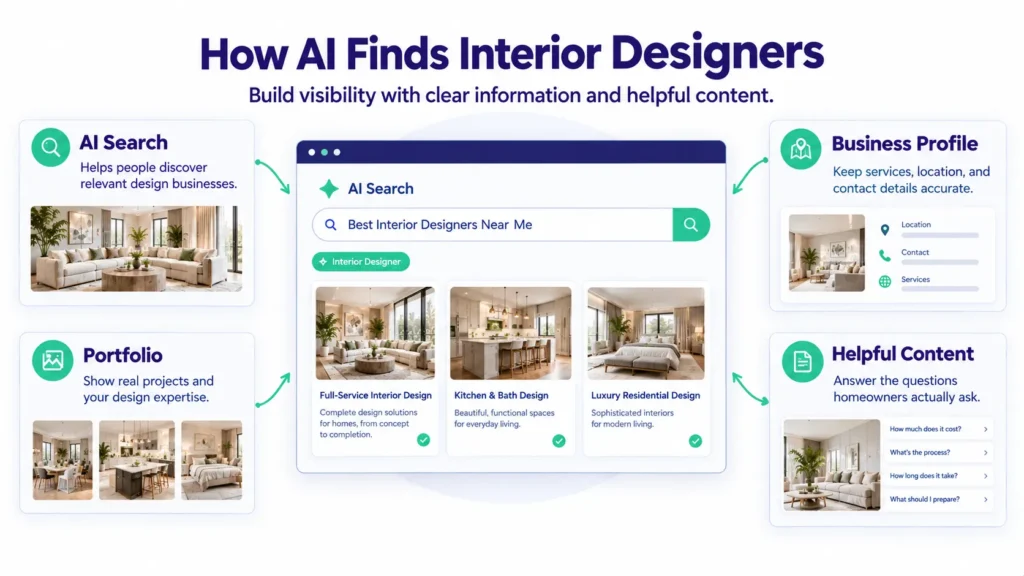
1. It rewrites questions into more specific searches. OpenAI explains that ChatGPT search typically turns a user’s question into one or more targeted queries, and sometimes sends them to partner search providers. A homeowner who asks for a good designer for a historic home may trigger a search closer to “historic home interior designer” plus a city name. Your pages need to match specific, descriptive phrasing like that.
2. It uses location. OpenAI says ChatGPT may use an approximate location based on IP address to show relevant local results, and that sharing a precise device location is optional. It may also share location with trusted providers that supply local information, such as nearby business listings. For a local service business, your location signals matter.
3. Placement isn’t guaranteed, and answers can be wrong. OpenAI states that ranking depends on multiple factors and that top placement can’t be guaranteed. It also warns that search results and citations can be incomplete, outdated, or incorrect, which is why people are encouraged to open the sources.
What isn’t public. OpenAI doesn’t publish a ranking checklist for local businesses. So what follows is informed inference: because ChatGPT may draw on results from other search providers, classic SEO likely remains the foundation of being found. That is our reasoning, not a documented rule.
Step 1: Let ChatGPT’s Crawler Reach Your Site
OpenAI’s crawler documentation lists separate bots with separate jobs:
- OAI-SearchBot surfaces websites in ChatGPT’s search features. Sites that opt out won’t be shown in ChatGPT search answers, though they can still appear as links. OpenAI recommends allowing it in your robots.txt file and allowing requests from its published IP ranges.
- GPTBot relates to model training, and it’s an independent setting. Blocking it is a different decision from blocking search.
- ChatGPT-User is used when a person asks ChatGPT to look at something. OpenAI notes that robots.txt rules may not apply to those user-initiated actions.
Check three things this week:
- Your robots.txt file doesn’t block OAI-SearchBot by accident.
- Your security plugin, firewall, or CDN isn’t blocking search bots.
- Your pages aren’t set to noindex, which can also keep a site out of search.
OpenAI notes that robots.txt changes can take about 24 hours to take effect for search.
Step 2: Map Real Questions to Real Pages
Because ChatGPT turns questions into targeted searches, your site needs a clear page for each kind of question a homeowner asks. Start with a simple map:
| Question a homeowner might ask | Page that should answer it |
|---|---|
| Best interior designer for a historic home in [city] | A niche service page, such as Historic Home Interior Design in [City] |
| How much does an interior designer cost? | A fees and pricing guide |
| Interior designer or decorator: what’s the difference? | A plain-language comparison article |
| How long does a whole-home design project take? | A process and timeline page |
| Interior designers who handle new construction near me | A new construction design service page |
| What should I ask before hiring an interior designer? | A hiring checklist article |
Collect real questions from discovery calls and inquiry forms, then build the pages in order of how much revenue each type of project represents. Avoid near-duplicate pages that only swap in different city names. Each page should have something genuinely useful for that topic.
Step 3: Write Pages That Are Easy to Quote
Whether a person or a tool is reading your page, clear writing wins. A few habits help:
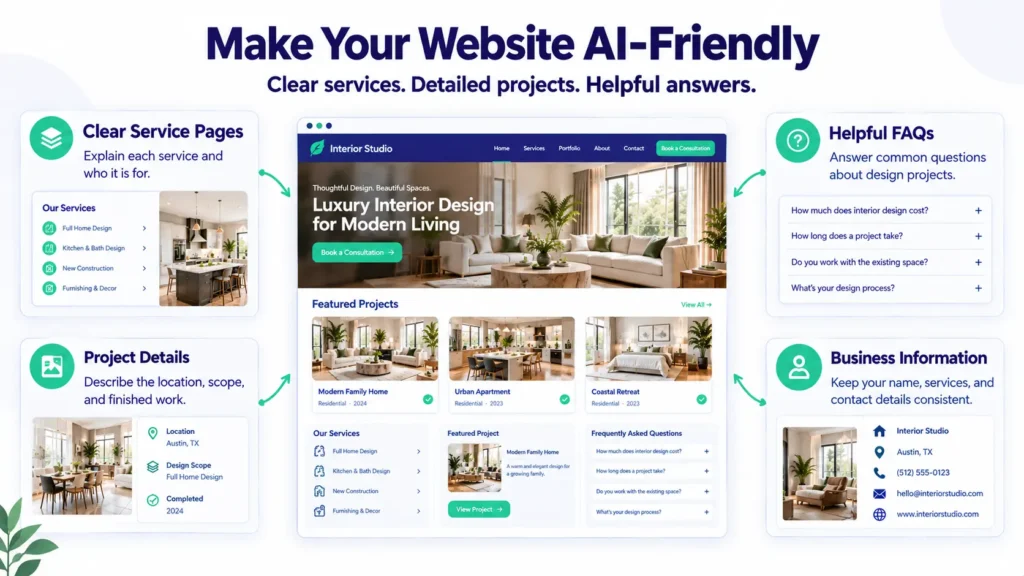
- Put the answer first. Under each question heading, answer in the first two or three sentences, then add detail.
- Be specific. Name your fee models, what affects cost, typical timelines, and what’s included.
- Define terms in plain language, such as “flat fee,” “cost-plus,” or “full-service.”
- Use structure. Short sections, descriptive headings, lists for steps, and a table when comparing options.
- Keep key facts in text, not only in images, sliders, or PDFs.
- Show when it was last reviewed, and update it when your process or services change.
Here’s what that looks like in a fee section. (This is a hypothetical example.)
Before: “Our fees vary by project and are tailored to your needs.”
After: “We offer two fee structures: a flat design fee for defined scopes, and hourly billing for consulting. Fees depend on square footage, scope, and whether we manage purchasing. We’ll recommend the best fit on your first call.”
The second version gives a reader, and any tool summarizing the page, something concrete to work with, without publishing numbers you’re not ready to share. For more topic ideas, browse our content marketing ideas for interior designers.
Step 4: Make Your Local Signals Clear
Since location shapes local results, give every system the same clear picture of where you work.
- Complete your Google Business Profile with accurate categories, real services, hours, a plain-language description, and regular project photos.
- Keep your name, address, and phone number identical across your website, social profiles, and directories.
- Name your service area on key pages, such as the title and opening paragraph of a service page, but only for places you genuinely serve.
- Publish local project pages that describe real work in specific areas, including the home’s style and what the design had to solve.
- Put your address, map, and contact details in text on your contact page.
Step 5: Build Proof That Holds Up When Someone Checks
OpenAI encourages people to open cited sources and verify what they read. That’s a good reminder that your claims need support when a homeowner follows the link.
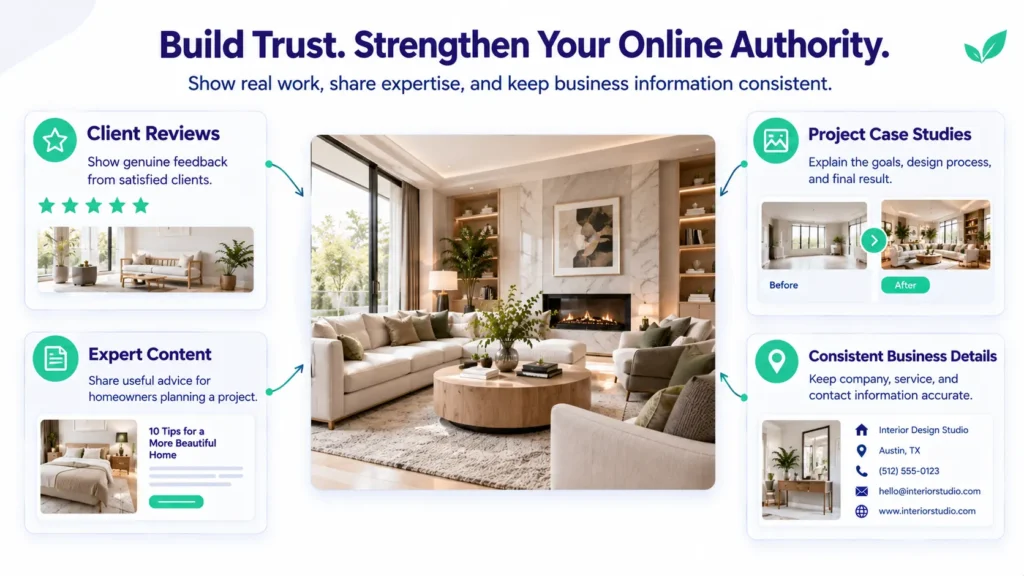
- Specific reviews that mention the project type and what the experience was like. Ask every client, send a direct review link, and reply to each review.
- Detailed project pages covering the brief, the challenge, the solution, and the timeline.
- Bios for the people behind the studio, with real experience and credentials.
- Credible outside mentions, such as local press, design publications, partner pages from builders or architects, and professional associations you genuinely belong to.
- Only real results. Never publish invented numbers, testimonials, or case studies.
Step 6: Keep the Technical Basics Clean
Nothing here is ChatGPT-specific, and that’s the point. A technically healthy site helps every search engine and tool that reads it.
- Fast, mobile-friendly pages
- A clear navigation structure and internal links between related pages
- An XML sitemap submitted to Google Search Console
- Descriptive title tags, headings, and image alt text
- Structured data that matches what’s visible on the page. Google’s own guidance says no special schema is needed for its AI features, and OpenAI hasn’t documented any schema requirement for ChatGPT search.
Step 7: Measure What You Can
As far as we can tell, OpenAI doesn’t offer a console or performance report for organic ChatGPT results, so you’ll need to piece together a picture:
- Test real prompts monthly. Write 10 to 15 questions covering your services, location, and project types. Run them in ChatGPT and note whether you’re mentioned, which competitors appear, and which sources are cited.
- Expect variation. Answers can change by person, location, and day, so look for patterns rather than single results.
- Check your analytics. Referral traffic from ChatGPT often shows up under chatgpt.com in analytics reports, though attribution isn’t always complete.
- Ask every new lead how they found you, and include ChatGPT as an option.
- Keep tracking traditional search in Google Search Console, since it remains the foundation.
Mistakes to Avoid
- Blocking OAI-SearchBot or search crawlers by accident
- Publishing near-duplicate city pages with swapped-in place names
- Buying fake reviews or posting invented testimonials
- Chasing one exact prompt instead of building useful pages for a whole category of questions
- Ignoring classic SEO and the Google Business Profile
- Trusting anyone who guarantees a ChatGPT placement
A 30-Day Checklist
- Week 1: Check robots.txt, firewall settings, and noindex tags. Write your positioning in one specific sentence.
- Week 2: Build your question-to-page map and clean up your Google Business Profile and listings.
- Week 3: Publish or rewrite one service page and one question-based article, answer-first and specific.
- Week 4: Ask five recent clients for reviews, run your first set of test prompts, and set up a simple log.
For more guidance, browse our Marketing category and the GrowthVia blog.
Conclusion
Getting found in ChatGPT doesn’t require a new playbook. It rewards a website that is easy for crawlers to reach, pages that match the specific questions homeowners ask, clear local signals, and proof that stands up to a closer look. Nobody can guarantee a mention, but studios that do this work give every search tool the best possible reason to include them.
Start with the crawler and indexing checks this week, then build one strong page at a time.